Recognising Communication Preferences
People don't wear a label that says Driver, Expressive, Amiable or Analytical. Instead, we recognise communication preferences by observing how people communicate.
Rather than making assumptions based on personality, role or first impressions, look for patterns in observable behaviour over time.
The five communication clues below provide a practical way to recognise communication preferences and make more informed decisions about how to communicate with others.

Behavioural observations
Click the icons below for more information.
-

Pace
-

Participation
-

Decision-making
-

Focus
-

Questions
1. Pace
Observe how quickly someone communicates and how they like conversations to progress.
-
Do they communicate quickly or at a more measured pace?
-
Do they want to keep the conversation moving or take time to explore?
2. Participation
Observe how they contribute to conversations.
-
Do they speak frequently and readily share their views?
-
Or do they tend to listen first, ask questions and invite input?
3. Decision-making
Observe how they approach decisions.
-
Do they make decisions quickly and move to action?
-
Or do they prefer time to consider options, gather information or seek input?
4. Focus
Observe what naturally captures their attention.
-
What do they naturally focus on?
-
Results and outcomes?
-
Ideas and possibilities?
-
People and relationships?
-
Facts and details?
5. Questions
Listen carefully to the questions they ask. Questions often provide some of the strongest clues about what someone values.
-
What do they ask about?
-
Are they asking what needs to happen next?
-
What else is possible?
-
How people will be affected?
-
What evidence or information is available?
Assertive or Responsive
As you're observing someone, you're really trying to answer two questions – how assertive and responsive someone appears.
1. Do they appear more or less assertive? (Ask or Tell)
-
Someone who appears more assertive, or tell-orientated, may communicate at a faster pace, speak more frequently, make statements, move conversations forward and make decisions more quickly.
-
Someone who appears less assertive, or ask-oriented, may communicate at a more measured pace, listen first, ask questions, invite discussion and take more time to explore options.
2. Do they appear more or less responsive?
-
Someone who appears more responsive may openly share their thoughts and reactions, communicate with warmth or energy and focus more on people, relationships or possibilities.
-
Someone who appears less responsive may be more reserved in their reactions, communicate in a calm or controlled way and focus more on tasks, facts, evidence or outcomes.
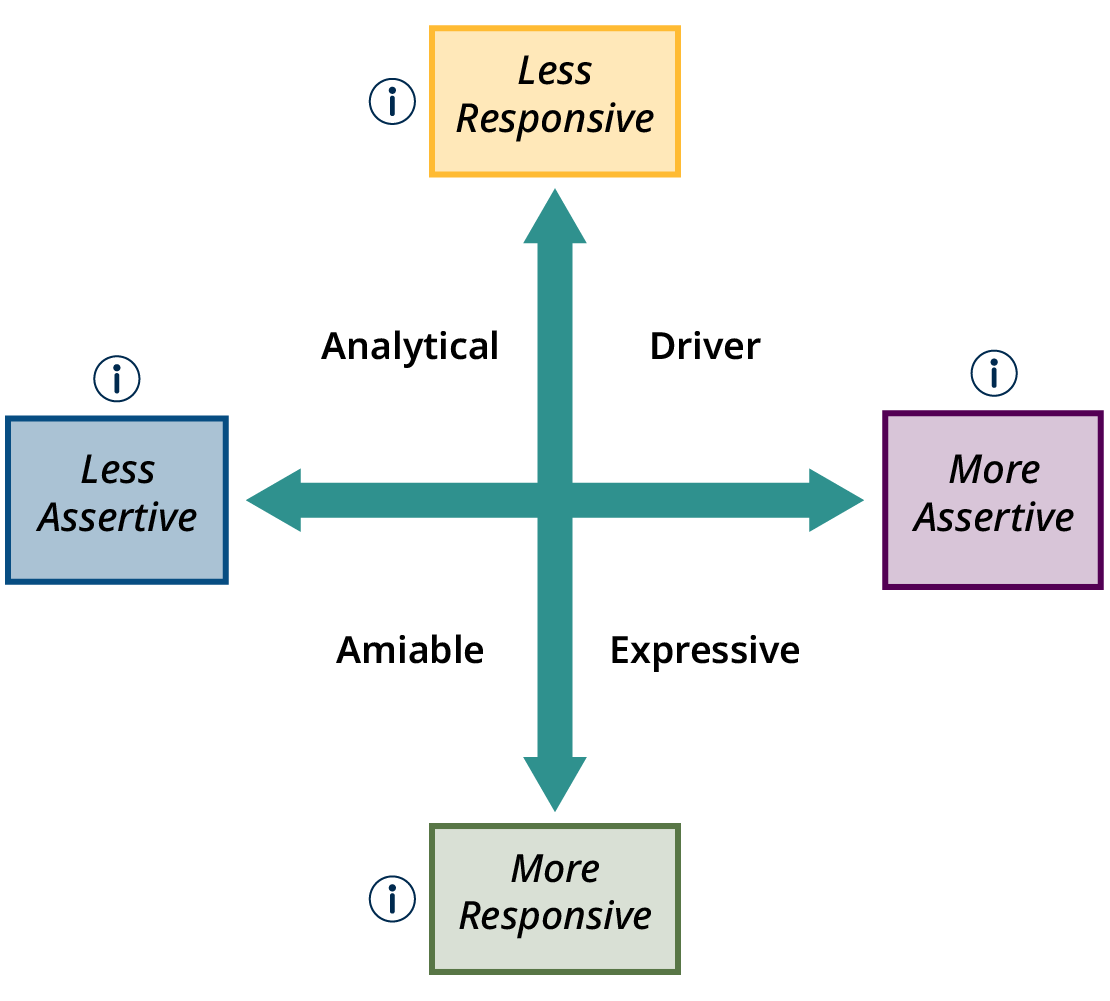
Click on each coloured box for more details.
Aligning to Social Styles
-
The more clues you observe, the easier it becomes to recognise communication preferences.
-
The table below provides a useful summary of the communication clues commonly associated with each Social Style.
-
Remember, this is a guide rather than a checklist. Most people display characteristics from more than one style, and communication preferences can change depending on the situation.
| Style | Driver | Expressive | Amiable | Analytical |
| Pace | Fast | Fast | Measured | Measured |
| Participation | Direct / tells | Discusses / thinks aloud | Listens / invites | Asks / listens |
| Decision-making | Quick | Explores before deciding | Seeks input or consensus | Deliberate |
| Focus | Results | Ideas | Relationships | Details |
| Often asks about... | Actions and outcomes | Possibilities | People impacts | Evidence and risks |
In summary
Remember:
-
No single behaviour provides the answer.
-
Look for patterns across several communication clues.
-
Communication preferences can change depending on the situation, workload or pressure.
-
Most people display characteristics from more than one Social Style.
The goal isn't to label people. It's to recognise communication preferences so you can make informed decisions about how to communicate more effectively.
