Understanding Social Styles
People communicate in different ways. Some prefer to move quickly and focus on outcomes, while others want time to consider information, explore ideas or understand how people may be affected.
-
Social Styles provides a practical framework for recognising these differences. It focuses on observable communication behaviours, rather than personality traits or fixed categories.
-
By recognising communication preferences, we can make small adjustments that improve understanding, collaboration and workplace relationships.

Flip over the cards below for more information.
Social Styles is
Social Styles is
-
A way to notice communication preferences
-
Based on observable behaviour
-
A guide for adapting communication
-
Flexible and dependent on context
Social Styles is not
Social Styles is not
-
A personality assessment
-
An explanation of why someone behaves a certain way
-
A way to label or diagnose people
-
A fixed description of someone
Behavioural dimensions
-
We can usually observe two aspects of how someone communicates.
-
Assertiveness
-
Responsiveness
-
-
Everyone communicates somewhere along both of these dimensions. When we combine them, four broad Social Styles emerge.
- Assertiveness
- Responsiveness
How someone tends to influence conversations.
At one end are people who tend to Ask. At the other end are people who tend to Tell.

|
Ask-oriented people often:
|
Tell-oriented people often:
|
At one end are people who communicate in a more controlled way. At the other end are people who communicate in a more expressive way.

|
Controlled people often:
|
Expressive people often:
|
Most people can communicate at either end of both dimensions. Social Styles describes the behaviours that appear most natural or consistent, not what someone is capable of doing.
-
Adaptive communication isn't about changing your personality. It's about making small adjustments that make it easier for someone else to hear and understand your message.
-
The Social Styles model gives us a practical way to do exactly that.
-
When we combine Assertiveness and Responsiveness, four broad Social Styles emerge.
-
Driver
-
Expressive
-
Amiable
-
Analytical
-
Adaptive communication isn't about changing your personality. It's about making small adjustments that make it easier for someone else to hear and understand your message.
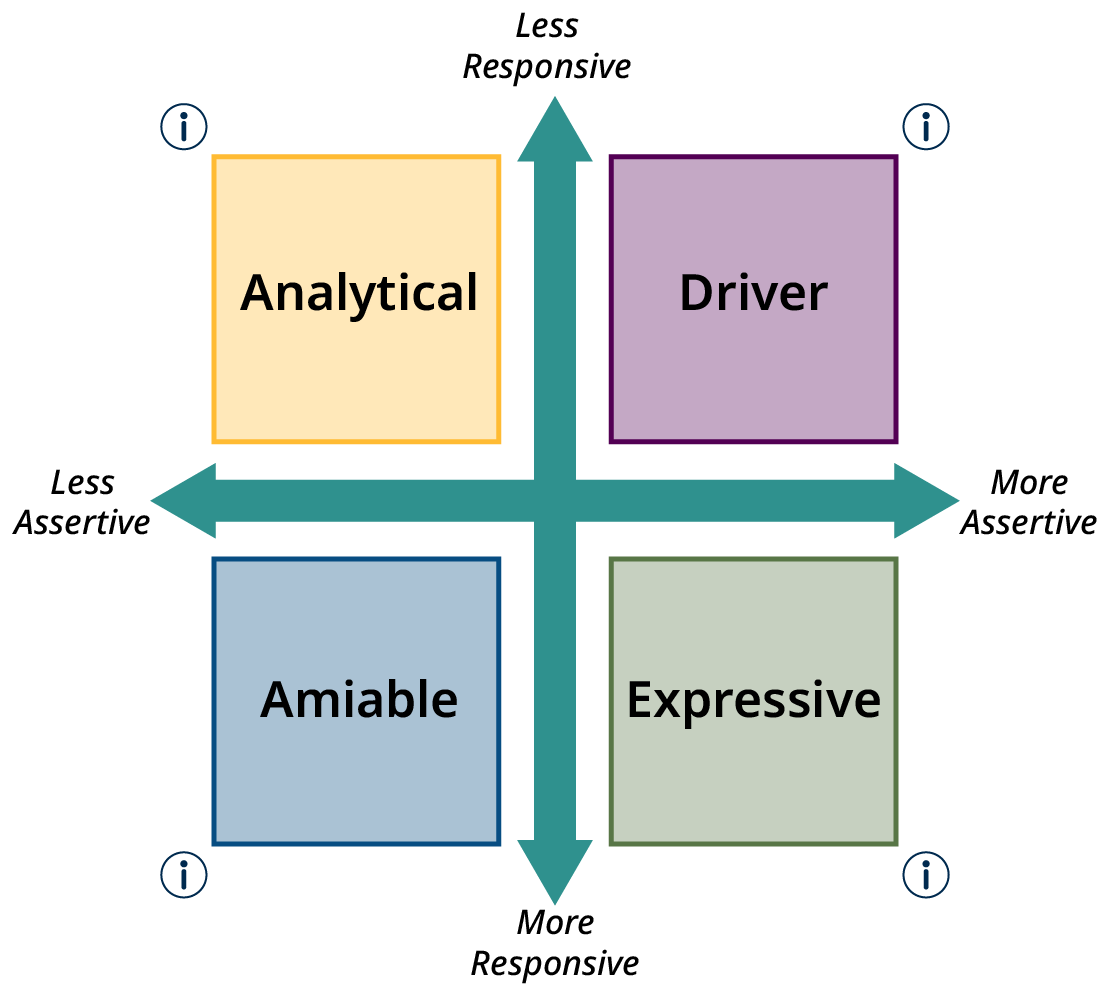
Click on each Social Style for more details.
In summary
Remember:
-
-
-
It helps recognise communication preferences so we can adapt our own communication more effectively.
