AcciMaps was developed by Rasmussen to help model broader system influences on accident causation.
They help identify factors that contribute to incidents at various system levels, and the relationships between these factors.
AcciMaps promotes effective, system-wide solutions for improving patient safety in complex healthcare environments.
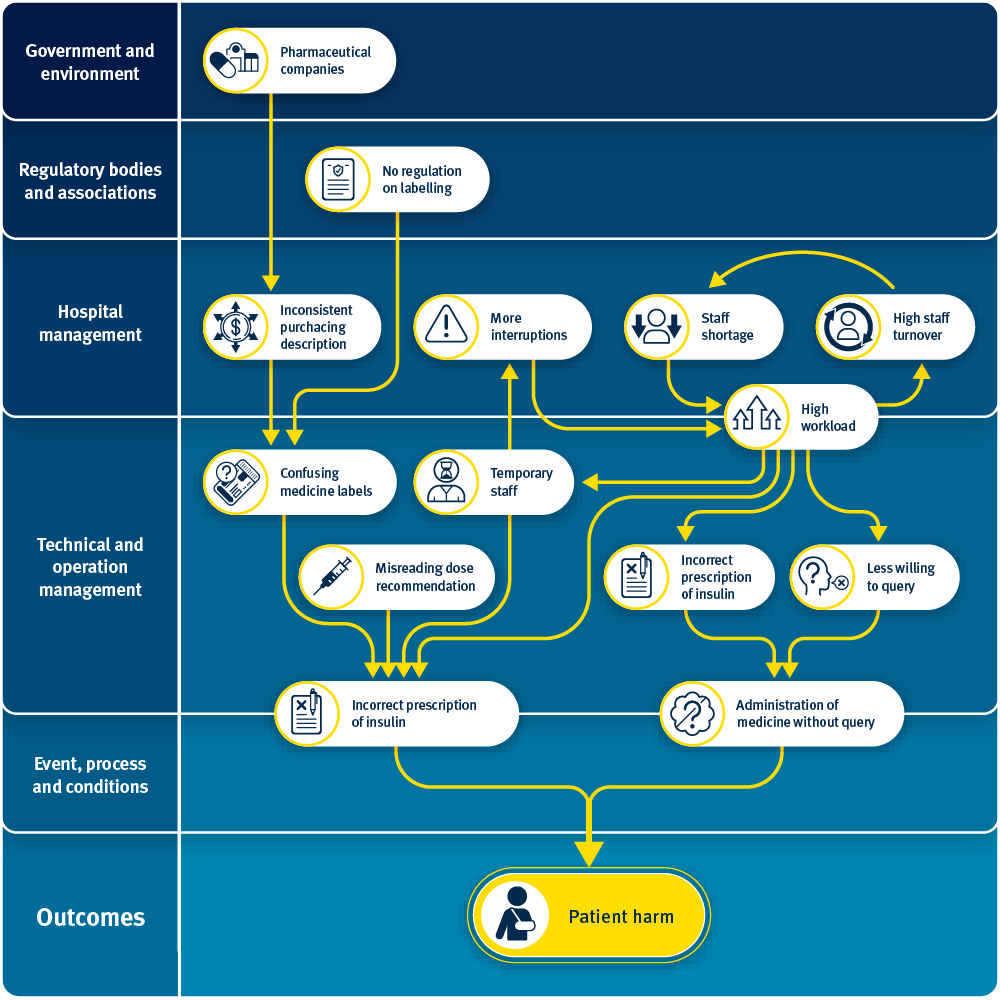
Example AcciMap showing systemic impacts leading to an over-prescription of insulin to a patient.
These System Levels include:
-
Events, processes and conditions:
e.g. Frontline actions, decisions, process failures, work design, environmental conditions. -
Technical and operational management:
e.g. Design and function of equipment, Staff training, work scheduling, patient management -
Hospital management:
e.g. Resource allocation, policies, leadership -
Regulatory bodies and associations:
e.g. External standards and guidelines. -
Government and environment:
e.g. Healthcare policy, legislation, environmental conditions, (pandemic), suppliers.
Benefits of using AcciMaps
-
Holistic view of Incidents:
Helps us take a broader look at why things go wrong. -
Identifying systemic failures:
Identify how higher-level decisions (e.g., policy changes, budget cuts) ripple down to affect clinical practices and outcomes. -
Effective communication tool:
Better communication of the causes of incidents driving collaborative solutions and support for systemic change. -
Proactive improvement:
Helps identify patterns across multiple events so organisations can proactively address system weaknesses. -
Informed decision-making:
Enables more informed decision-making when designing.
How to use an AcciMap
-
Map incident:
Collect information about the incident at each level. Document what happened and why. -
Link contributing factors:
Draw connections between different levels to show how higher-level decisions (e.g., policies) impact front-line actions. -
Analyse for solutions:
Use to identify areas for systemic change, focusing on improving processes across all levels, not just individual actions.
