Cost centre management
A cost centre is a code allocated to a department, unit or ward. It’s a bit like a bank account for a work unit. Money can be budgeted, adjusted and spent from a cost centre to deliver a range of outputs and services, such as patient care or reports. Cost centres help people-leaders to better utilise resources by giving them a clearer understanding of how resources are being used.

What are the costs?
Cost centre allocation is a process of attributing all costs involved in a particular activity to one ‘location’ or ‘cost centre’. Some types of costs you will encounter include:

Material costs
All materials used directly (including wasted materials) and materials used indirectly (e.g. packaging).

Labour costs
All labour costs directly involved in the activity (e.g. nursing staff). Line Managers should monitor fortnightly pay reports that are distributed to ensure overtime allowances are correct.

Overhead costs
Proportionate costs of regular expenses associated with that activity (e.g. rent, rates, power, interest repayments, etc.).
Why is it important to monitor my costs?
-
Monitor efficiency – Cost centres allow you to monitor the effectiveness of all aspects of your organisation closely.
-
Prevent loss – Cost centres allow you to update processes and be more effective with spending money.
-
Boost employee confidence – Making employees accountable for their cost centre is a way to improve accountability and confidence.
-
Make managers more efficient – Comparing cost data from different time periods to find ways to keep costs under control.
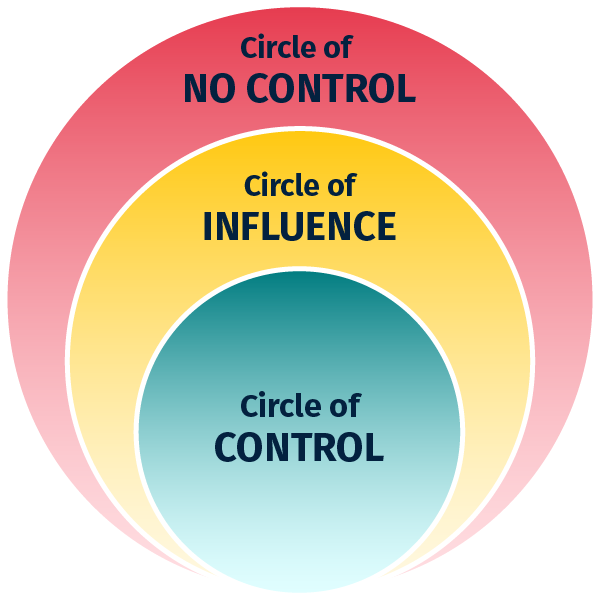
Your areas of influence
- Circle of No Control
- Circle of Influence
- Circle of Control
Circle of No Control
Things you cannot control
These may include:
-
The service agreement
-
Changes to government policy
-
Staffing ratios.
If you focus all your energy on things you cannot change, you may not only drain yourself but also risk being perceived as overly negative or critical. The key is to identify where your influence ends and develop contingency plans for factors outside your control.
Circle of Influence
Things you can influence or contribute to
These may include:
-
Resource distribution to your unit
-
The budget your area receives
-
Perception of value for your unit.
You can influence how others perceive your department's needs by presenting clear, data-driven justifications.
Maximise your influence by building strong relationships with key stakeholders and demonstrating value through the effective use of current resources.
Circle of Control
Things you can control
These may include:
-
Operational cost management
-
Financial reporting
-
Resource allocation
-
Compliance and efficiency
The key is to prioritise your resources and efforts in these areas. Doing so will help you drive meaningful change. As you succeed, others may recognise your effectiveness, and you may find your influence growing.
Attention
Participate in a monthly meeting with the Finance Officer to review your cost centre, discuss expenditure and assist you with planning and monitoring your cost centre as these are things you can control.
Why it's important
-
Ensures resources are used efficiently.
-
Maximises value by directing funds to the highest-priority activities.
-
Supports service delivery to ensure critical needs are met.
-
Provides data for information decision-making and future budget planning.
-
Ensure ethical use of public funds.
Domino Effect Game
The Domino Effect game is an interactive activity that explores how everyday management decisions, documentation and data quality can create flow-on effects for your funding and financial outcomes.
You will respond to a range of workplace scenarios, gaining or losing funding tokens and identifying the broader 'domino effect' each issue could have on your budget, team or compliance.
Play on your own or grab your team to test their knowledge.